30-session Nursing Conversations plan

Spanish for nurses who want to practice real patient conversations

Build confidence asking about symptoms, explaining everyday care, checking understanding, and handling common nursing conversations—all through guided speaking practice.
See all 30 sessions
  • 30guided sessions
  • Intermediate–advancedlearner level
  • Your pacerepeat any scenario
Ready-made learning plan
Nursing Conversations Spanish speaking practice
30 focused topicsStart today
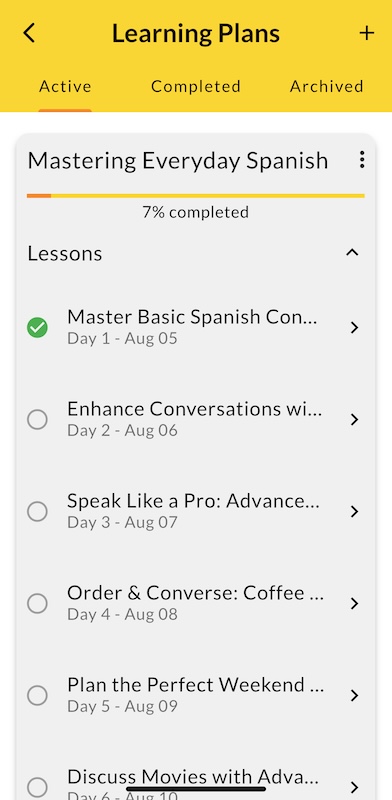
Learning plan screen in the Amigo Lingo app

Built for speaking, not memorizing lists

Practice the conversations nursing actually requires

General Spanish lessons rarely spend enough time on patient-centered communication. This plan gives each session a practical nursing goal so you always know what to practice next.

01

Speak through realistic situations

Practice what you might say during intake, bedside care, discharge, family questions, and handoff.

02

Get feedback while you learn

Review translations, pronunciation guidance, and conversation feedback without the pressure of a live clinical encounter.

03

Build a repeatable routine

Follow 30 focused sessions in sequence, practice on your schedule, and repeat the situations that need more work.

The complete curriculum

What you’ll practice in 30 sessions

The plan moves from patient introductions and focused questions to more complex supportive conversations, handoffs, and full simulations.

Phase 1 Days 1–5

Patient intake

Open the conversation calmly and collect the essential details.

  1. Greet the patient and explain your role
  2. Confirm name, date of birth, and identifying details
  3. Ask the reason for the visit
  4. Ask when symptoms started and what changes them
  5. Describe the location, intensity, and type of pain
Phase 2 Days 6–10

Safety and care preparation

Practice clear questions and explanations before providing care.

  1. Ask about allergies and current medicines
  2. Explain vital-sign checks and next steps
  3. Ask about medical history, surgery, and hospital visits
  4. Explain what you will do before beginning care
  5. Ask permission and check privacy and comfort
Phase 3 Days 11–15

Everyday bedside communication

Build the language used during routine patient care.

  1. Give simple positioning and breathing instructions
  2. Explain safe movement and how to ask for help
  3. Ask about food, fluids, and tolerance
  4. Discuss bathroom, hygiene, and comfort needs
  5. Confirm medicine names, timing, and concerns
Phase 4 Days 16–20

Response and follow-up

Check for changes and practice common discharge conversations.

  1. Ask about improvement, side effects, and new symptoms
  2. Explain basic dressing care
  3. Practice a clear discharge conversation
  4. Confirm follow-up dates, locations, and preparation
  5. Discuss warning signs and contacting the care team
Phase 5 Days 21–25

Supportive conversations

Stay calm, respectful, and clear in more sensitive moments.

  1. Reassure an anxious patient and explain what happens next
  2. Give appropriate updates to family members
  3. Offer extra support and check understanding
  4. Explain delays and when you will return
  5. Ask sensitive questions respectfully
Phase 6 Days 26–30

Team communication and simulations

Bring the plan together through handoffs and full scenarios.

  1. Give a concise shift handoff
  2. Repair misunderstandings and ask for language support
  3. Respond to frustration about pain, waiting, or instructions
  4. Complete a full admission simulation
  5. Complete a full-shift patient-care scenario

A preview of the language

Start with calm, clear questions

The goal is not to memorize a giant glossary. It is to practice complete exchanges until you can ask a question, understand the response, and continue the conversation.

Practice examples only. Adapt language to your role and workplace policies, and use qualified language assistance when required.
01

Hola, soy su enfermero / enfermera. Me llamo…

Hello, I’m your nurse. My name is…
02

¿Puede decirme su nombre y fecha de nacimiento?

Can you tell me your name and date of birth?
03

¿Dónde le duele?

Where does it hurt?
04

Del cero al diez, ¿qué tan fuerte es el dolor?

From zero to ten, how strong is the pain?
05

¿Tiene alergia a algún medicamento?

Are you allergic to any medication?
06

Voy a explicarle lo que vamos a hacer.

I’m going to explain what we’re going to do.

How it works

Turn a learning plan into a speaking habit

1

Choose Nursing Conversations

Open the ready-made plans in Amigo Lingo and select the 30-session nursing plan.

2

Practice the day’s situation

Speak with an AI language partner about the focused nursing topic for that session.

3

Review and repeat

Use conversation feedback and pronunciation support, then revisit any scenario as needed.

Know the boundary

Language practice supports care. It does not replace language access.

Amigo Lingo helps learners rehearse Spanish conversations in a low-pressure environment. It is not a medical interpreter, clinical tool, or proof of professional language proficiency.

For real patient care, follow your employer’s policies and use a qualified interpreter whenever one is required for accurate, safe, and confidential communication.

Questions about the plan

Spanish for nurses FAQ

Who is the Spanish for Nurses plan designed for?
The ready-made Nursing Conversations plan is designed for intermediate and advanced Spanish learners, including nurses and nursing students who want more focused speaking practice. If you are a complete beginner, build a basic conversational foundation before starting the full plan.
What will I practice?
You will practice 30 guided conversation topics covering patient greetings, identity checks, symptoms, pain, allergies, vital signs, daily care, medication conversations, discharge, family updates, shift handoffs, and full patient-care simulations.
Do I have to complete the plan in exactly 30 days?
No. The plan gives you 30 focused sessions and a clear order to follow, but you can practice at a pace that fits your schedule and repeat conversations when you want more confidence.
Can I practice a regional variety of Spanish?
Yes. Amigo Lingo can use your selected regional Spanish preference during conversation practice, helping you prepare for the communities you are most likely to serve.
Does Amigo Lingo replace a qualified medical interpreter?
No. Amigo Lingo is an educational conversation-practice app. It is not a medical interpreter, certification program, or clinical decision tool. Follow your organization’s language-access policies and use a qualified interpreter whenever one is required for safe, accurate patient communication.
Is this a medical Spanish certification course?
No. The plan helps you practice spoken Spanish for common nursing situations, but it does not provide professional certification or verify clinical language proficiency.

Your first session is ready

Practice the Spanish conversations you want ready before you need them.

Download Amigo Lingo and choose the Nursing Conversations learning plan.