Spanish learning guide
Spanish Conversation Starters: 90 Questions for B1–B2 Learners
Use 90 Spanish conversation starters, questions, and topics designed to help intermediate learners tell stories, express opinions, and keep talking.
On this page
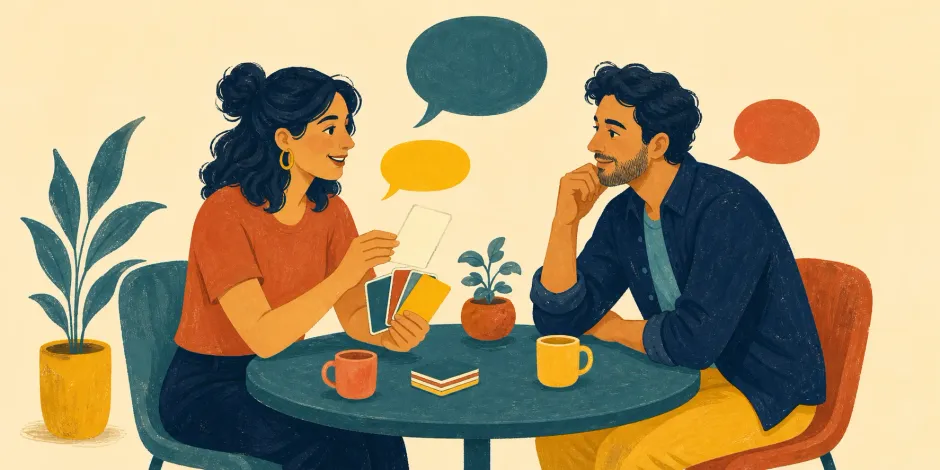
You sit down to practice Spanish with a tutor, friend, or conversation app. You exchange greetings, talk about the weather, and then reach the same awkward question: What do we talk about now?
The best Spanish conversation starters do more than fill silence. They invite a story, an opinion, or a follow-up question. That is especially important once you reach an intermediate level. You no longer need another list of ways to say your name or order coffee. You need reasons to explain, compare, disagree, remember, and imagine in Spanish.
This guide gives you 90 conversation questions and topics for B1–B2 practice. The English translations are there when you need them, but try responding to the Spanish before reading across the line.
The Best Spanish Conversation Starters to Use First
If you want to start talking immediately, try one of these:
- ¿Qué ha sido lo mejor de tu semana hasta ahora? — What has been the best part of your week so far?
- ¿Qué has aprendido últimamente que te sorprendió? — What have you learned recently that surprised you?
- ¿Hay algo que antes no te gustaba y ahora sí? — Is there something you did not use to like but now do?
- ¿Qué lugar te gustaría conocer y por qué? — What place would you like to visit and why?
- ¿Qué problema te gustaría saber resolver mejor? — What problem would you like to be better at solving?
- Si tuvieras una tarde completamente libre, ¿qué harías? — If you had a completely free afternoon, what would you do?
These work because a one-word answer is possible but unsatisfying. The speaker naturally wants to add a reason, example, or story.
How to Turn One Question into a Real Conversation
A list of 90 questions can still produce 90 short answers. To make the practice conversational, use this four-move pattern:
- Answer directly. Give your main idea in one sentence.
- Add a reason or example. Use porque, por ejemplo, or lo que pasa es que.
- Invite a follow-up. Pause instead of rushing to the next question.
- Return the question. Use ¿Y tú?, ¿Qué opinas?, or a more specific follow-up.
For example:
¿Qué lugar te gustaría conocer? Me gustaría conocer Colombia porque me interesa mucho su diversidad cultural. Una amiga fue a Medellín el año pasado y me habló de la gente y de la comida. ¿Tú ya has estado allí?
That is already a small conversation, not a vocabulary test.
Useful follow-up questions include:
- ¿Por qué? — Why?
- ¿Desde cuándo? — Since when?
- ¿Cómo fue? — What was it like?
- ¿Qué pasó después? — What happened next?
- ¿Puedes darme un ejemplo? — Can you give me an example?
- ¿Siempre has pensado así? — Have you always thought that?
- ¿Qué harías de otra manera? — What would you do differently?
Everyday Conversation Starters
These questions feel relaxed, but they still require more than beginner Spanish.
- ¿Qué ha sido lo mejor de tu semana hasta ahora? — What has been the best part of your week so far?
- ¿Qué te ha mantenido ocupado/a últimamente? — What has kept you busy lately?
- ¿Hay algo que esperas con ganas este mes? — Is there something you are looking forward to this month?
- ¿Has descubierto últimamente alguna serie, comida o lugar que recomendarías? — Have you recently discovered a show, food, or place you would recommend?
- ¿Qué pequeño cambio ha mejorado tu rutina? — What small change has improved your routine?
- ¿Qué parte del día disfrutas más normalmente? — What part of the day do you usually enjoy most?
- ¿Cómo sería para ti un domingo ideal? — What would an ideal Sunday look like for you?
- ¿Qué suele hacerte reír? — What usually makes you laugh?
- ¿Qué plan cancelado te alegró secretamente? — What canceled plan secretly made you happy?
- Si pudieras repetir un momento de ayer, ¿cuál elegirías? — If you could repeat one moment from yesterday, which would you choose?
Habits, Preferences, and Personality
Use these to practice comparisons, frequency, and explaining how you have changed.
- ¿Prefieres planearlo todo o improvisar? — Do you prefer to plan everything or improvise?
- ¿Qué hábito te gustaría mantener durante los próximos años? — What habit would you like to maintain over the next few years?
- ¿Qué costumbre te cuesta entender de otras personas? — What habit of other people is hard for you to understand?
- ¿Trabajas mejor con silencio o con ruido de fondo? — Do you work better in silence or with background noise?
- ¿Qué decisión pequeña tomas demasiado en serio? — What small decision do you take too seriously?
- ¿Eres la misma persona por la mañana que por la noche? — Are you the same person in the morning as at night?
- ¿Qué actividad te ayuda a recuperar energía? — What activity helps you regain energy?
- ¿Qué te resulta más difícil: empezar algo o terminarlo? — What is harder for you: starting something or finishing it?
- ¿Hay algo popular que a ti no te interese? — Is there something popular that does not interest you?
- ¿Qué habilidad cotidiana se te da sorprendentemente bien? — What everyday skill are you surprisingly good at?
Recent Experiences and Stories
These prompts are ideal for practicing the preterite and imperfect together.
- ¿Cuándo fue la última vez que cambiaste de opinión sobre algo? — When was the last time you changed your mind about something?
- ¿Qué conversación reciente recuerdas especialmente? — What recent conversation do you particularly remember?
- ¿Alguna vez un plan salió mejor de lo que esperabas? — Has a plan ever turned out better than you expected?
- ¿Qué error reciente te enseñó algo útil? — What recent mistake taught you something useful?
- ¿Cuándo fue la última vez que ayudaste a alguien? — When was the last time you helped someone?
- ¿Has tenido alguna coincidencia difícil de creer? — Have you experienced a coincidence that was hard to believe?
- ¿Qué experiencia te hizo sentir fuera de tu zona de confort? — What experience made you feel outside your comfort zone?
- ¿Recuerdas una vez que tuviste que improvisar una solución? — Do you remember a time when you had to improvise a solution?
- ¿Qué momento de tu infancia puedes describir con muchos detalles? — What moment from your childhood can you describe in detail?
- ¿Qué viaje, evento o reunión no salió como estaba previsto? — What trip, event, or gathering did not go as planned?
When you tell the story, set the scene first, then move through the events. Spanish transition words such as de repente, entonces, and al final will help your listener follow the timeline.
Travel, Places, and Culture
These questions move beyond basic travel logistics and into experience, identity, and comparison.
- ¿Qué lugar te ha sorprendido más de lo que esperabas? — What place surprised you more than expected?
- ¿Qué hace que una ciudad sea agradable para vivir? — What makes a city pleasant to live in?
- ¿Prefieres volver a un lugar conocido o descubrir uno nuevo? — Do you prefer returning to a familiar place or discovering a new one?
- ¿Qué comida representa bien el lugar donde creciste? — What food represents the place where you grew up?
- ¿Qué tradición de tu familia o comunidad te gustaría conservar? — What tradition from your family or community would you like to preserve?
- ¿Qué aspecto de tu cultura suele ser difícil de explicar? — What aspect of your culture is usually difficult to explain?
- ¿Cómo cambia tu personalidad cuando viajas? — How does your personality change when you travel?
- ¿Qué destino recomendarías para un viaje tranquilo? — What destination would you recommend for a relaxing trip?
- ¿Qué aprendiste al convivir con personas de otro lugar? — What did you learn from spending time with people from another place?
- ¿Qué lugar de tu región merece más atención? — What place in your region deserves more attention?
Work, Learning, and Technology
These topics are useful when you want to practice explaining processes, goals, and tradeoffs.
- ¿Qué parte de tu trabajo o tus estudios te da más satisfacción? — What part of your work or studies gives you the most satisfaction?
- ¿Qué habilidad te gustaría aprender si tuvieras más tiempo? — What skill would you like to learn if you had more time?
- ¿Qué consejo profesional te ha servido de verdad? — What professional advice has genuinely helped you?
- ¿Aprendes mejor observando, leyendo o haciendo? — Do you learn better by watching, reading, or doing?
- ¿Qué tarea debería ser más fácil gracias a la tecnología, pero no lo es? — What task should be easier because of technology, but is not?
- ¿Qué aplicación o herramienta usas más de lo que te gustaría? — What app or tool do you use more than you would like?
- ¿Qué hace que una reunión sea útil? — What makes a meeting useful?
- ¿Preferirías trabajar cuatro días largos o cinco días más cortos? — Would you rather work four long days or five shorter days?
- ¿Qué te gustaría que la gente entendiera mejor sobre tu profesión? — What would you like people to understand better about your profession?
- ¿Qué tema podrías explicar sin prepararte? — What topic could you explain without preparing?
Relationships and Community
Choose questions that fit the trust you already have with the other person. A good conversation starter should create connection, not pressure.
- ¿Qué cualidad valoras más en una amistad? — What quality do you value most in a friendship?
- ¿Qué hace que alguien sea buen oyente? — What makes someone a good listener?
- ¿Cómo mantienes el contacto con personas que viven lejos? — How do you keep in touch with people who live far away?
- ¿Qué tipo de ayuda te cuesta pedir? — What kind of help is difficult for you to ask for?
- ¿Qué detalle pequeño puede mejorar el día de alguien? — What small gesture can improve someone’s day?
- ¿Prefieres resolver un desacuerdo enseguida o esperar un poco? — Do you prefer resolving a disagreement immediately or waiting a while?
- ¿Quién te enseñó algo que todavía usas hoy? — Who taught you something that you still use today?
- ¿Qué actividad reúne a la gente en tu comunidad? — What activity brings people together in your community?
- ¿Qué conversación importante suele evitar la gente? — What important conversation do people tend to avoid?
- ¿Cómo ha cambiado tu manera de hacer amigos con el tiempo? — How has the way you make friends changed over time?
Opinions and Tradeoffs
At B1–B2, the useful challenge is not merely stating an opinion. It is supporting it and responding to another viewpoint.
- ¿Es mejor tener muchas opciones o pocas opciones buenas? — Is it better to have many options or a few good ones?
- ¿Deberían las ciudades tener más espacios sin coches? — Should cities have more car-free spaces?
- ¿Qué vale más: ahorrar tiempo o ahorrar dinero? — What matters more: saving time or saving money?
- ¿Las redes sociales nos conectan o nos distraen más? — Do social networks connect us or distract us more?
- ¿Es posible separar completamente el trabajo de la vida personal? — Is it possible to completely separate work from personal life?
- ¿Qué debería enseñarse en la escuela y normalmente no se enseña? — What should be taught in school that normally is not?
- ¿Es mejor dominar una habilidad o saber un poco de muchas? — Is it better to master one skill or know a little about many?
- ¿Cuándo merece la pena pagar más por algo? — When is something worth paying more for?
- ¿La comodidad siempre mejora nuestra vida? — Does convenience always improve our lives?
- ¿Qué responsabilidad tienen las personas al compartir información en internet? — What responsibility do people have when sharing information online?
Use Spanish conjunctions such as aunque, sin embargo, por un lado and por otro lado to make the contrast in your answer explicit.
Hypothetical and Creative Questions
Hypothetical questions make you use the conditional and imperfect subjunctive while still talking about ideas that feel personal.
- Si pudieras vivir un año en otra época, ¿cuál elegirías? — If you could live for a year in another era, which would you choose?
- Si mañana tuvieras un día libre inesperado, ¿cómo lo aprovecharías? — If you unexpectedly had tomorrow free, how would you use it?
- Si pudieras eliminar una tarea cotidiana, ¿cuál sería? — If you could eliminate one everyday task, which would it be?
- Si abrieras un pequeño negocio, ¿qué ofrecerías? — If you opened a small business, what would you offer?
- Si solo pudieras conservar tres aplicaciones, ¿cuáles elegirías? — If you could keep only three apps, which would you choose?
- Si pudieras hacerle una pregunta a tu versión de dentro de diez años, ¿qué preguntarías? — If you could ask your future self one question, what would you ask?
- Si tu ciudad recibiera mucho dinero para una sola mejora, ¿en qué debería gastarlo? — If your city received a lot of money for one improvement, what should it spend it on?
- Si pudieras aprender una habilidad instantáneamente, ¿cuál tendría mayor impacto en tu vida? — If you could learn one skill instantly, which would have the greatest impact on your life?
- Si no existieran los teléfonos inteligentes, ¿qué cambiaría más? — If smartphones did not exist, what would change most?
- Si tuvieras que organizar una cena para cinco personas famosas, ¿a quién invitarías? — If you had to organize a dinner for five famous people, whom would you invite?
Deeper B2 Conversation Topics
These are better for a partner you already know or for a structured lesson. They ask you to define ideas, acknowledge exceptions, and defend a position.
- ¿Qué significa para ti tener éxito? — What does being successful mean to you?
- ¿Hasta qué punto somos responsables de cambiar hábitos que aprendimos de niños? — To what extent are we responsible for changing habits we learned as children?
- ¿Puede una decisión ser correcta aunque tenga consecuencias negativas? — Can a decision be right even if it has negative consequences?
- ¿Qué perdemos cuando todo se vuelve más eficiente? — What do we lose when everything becomes more efficient?
- ¿Cómo influye el idioma que hablamos en nuestra forma de pensar? — How does the language we speak influence the way we think?
- ¿Es más importante sentirse parte de una comunidad o mantener la independencia? — Is it more important to feel part of a community or maintain independence?
- ¿Cuándo debería una tradición cambiar? — When should a tradition change?
- ¿Qué diferencia hay entre estar informado y comprender realmente un tema? — What is the difference between being informed and truly understanding a topic?
- ¿Deberíamos juzgar las decisiones pasadas con los valores actuales? — Should we judge past decisions using current values?
- ¿Qué avance tecnológico crees que cambiará más nuestras conversaciones? — What technological advance do you think will change our conversations most?
A 15-Minute Conversation Practice Routine
Do not attempt all 90 questions in order. Use a small set repeatedly:
- Choose three questions from one section.
- Speak for 60–90 seconds on each one.
- Ask or answer at least two follow-up questions.
- Note one phrase you wanted but could not produce.
- Repeat your weakest answer with that phrase included.
Speak out loud
From Short Answer to Real Conversation
Goal: Build a five-minute conversation from one question instead of racing through a list.
Choose a prompt
- ¿Qué pequeño cambio ha mejorado tu rutina?
- ¿Qué error reciente te enseñó algo útil?
- ¿Qué vale más: ahorrar tiempo o ahorrar dinero?
How to do it
- Choose one prompt and answer it directly in one sentence.
- Add a reason, a specific example, and one contrast.
- Have your partner ask two follow-up questions—or invent the questions yourself and answer them.
- Retell your answer in a shorter, clearer version.
Make it harder
- Use porque, aunque, and por ejemplo at least once.
- Use one natural Spanish filler word while you think.
- Finish by returning a specific question to your partner.
Hear what a strong response could sound like
Un pequeño cambio que ha mejorado mi rutina es dejar el teléfono fuera del dormitorio. Antes lo miraba apenas me despertaba y perdía mucho tiempo. Aunque al principio me costó, ahora empiezo el día con más calma. Por ejemplo, tengo tiempo para desayunar sin prisa. ¿Tú tienes alguna regla para usar menos el teléfono?
Coach's note: If the second version is clearer than the first, the exercise worked. Fluency grows through better repeats, not endless new questions.
If you need help holding the floor while you think, learn a small set of Spanish filler words rather than translating um and like directly.
Conversation Starters for Tutors, Exchanges, and AI Practice
The same list works differently depending on your partner:
- With a tutor: ask for corrections only after you finish your answer so the conversation can develop.
- With a language exchange partner: alternate questions and give both languages equal time.
- By yourself: record an answer, invent one follow-up, and record a second version.
- With an AI partner: ask it to stay on one topic, challenge vague answers, and correct your three most important errors afterward.
For a broader practice plan, see our guide to conversational Spanish practice. If you want structured solo drills rather than partner questions, continue with our Spanish speaking prompts for B1–B2 learners.
FAQ: Spanish Conversation Starters
What are the best Spanish conversation starters?
Are these questions suitable for intermediate Spanish learners?
How many questions should I practice at once?
How do I keep a Spanish conversation going after the first answer?
Can I use these conversation questions without a partner?
Turn a Question into Something You Can Say Naturally
You do not need to memorize 90 polished answers. Choose a few questions that make you want to speak, learn the language your answers require, and return to them until the conversation feels easier.
Practice These Questions in a Real Spanish Conversation
Choose a topic in Amigo Lingo, answer naturally, and get feedback that helps your next attempt sound clearer and more confident.
Start a Conversation